
Cervical spine conditions
Neck, arms, hands: listening to the signals.
Pain running into the arm, tingling fingers, hands that feel less precise. The causes vary and deserve careful assessment.
Private visits and care pathways, not covered by the Italian National Health Service (SSN/ASL). A consultation involves no commitment to surgery.
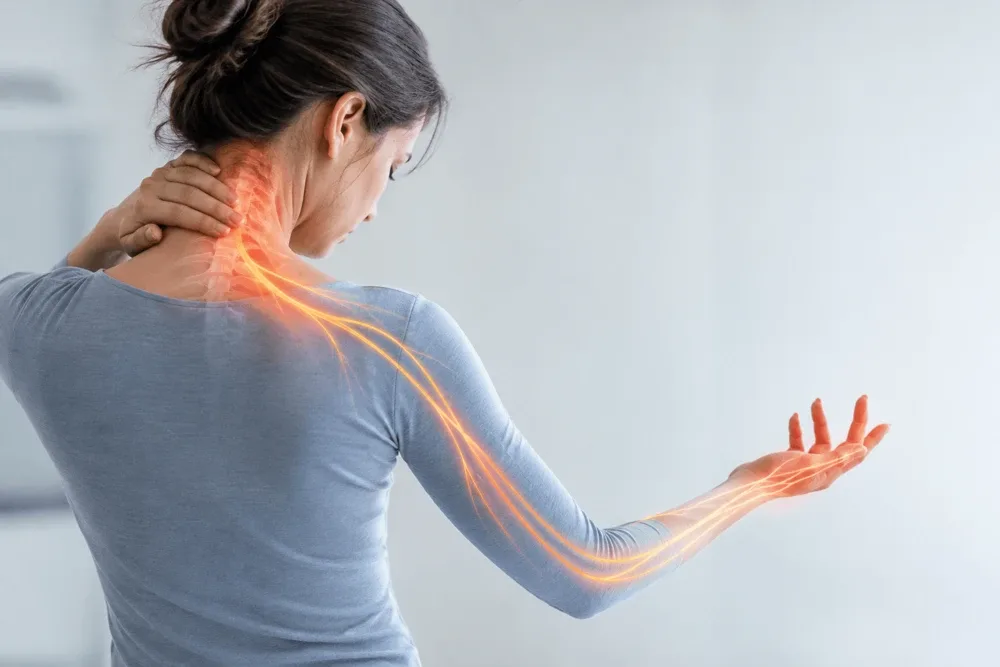
What it is, in plain words
The neck carries the spinal cord and the nerve roots that go to the arms. A disc herniation or arthritis can reduce the space and compress them.
It's important to understand which structure is involved: a nerve root or the spinal cord.
Common symptoms
- Neck pain spreading to the shoulder and arm
- Tingling or numbness in the fingers
- Weakness in the arm or hand
- Difficulty with fine tasks, such as buttoning or writing
Radiculopathy or myelopathy: an important difference
Radiculopathy
Compression of a nerve root. Pain, tingling or weakness in one arm, along a specific path. It often improves with conservative care.
Possible spinal cord involvement (myelopathy)
Clumsy hands, loss of dexterity, unsteady walking, sometimes on both sides. It needs specialist assessment without waiting too long.
The assessment
- Neurological examination of arms, hands and legs
- Cervical MRI interpreted alongside the clinical findings
- X-rays to assess alignment and stability; neurophysiological tests when helpful
- Assessment of changes over time
Conservative care
- 01
Physiotherapy
Exercises for mobility and posture, adapted to your symptoms.
- 02
Pain management
Targeted medication and, when indicated, guided injections.
- 03
Monitoring
Regular clinical check-ups, especially if the spinal cord is close to being compressed.
When to discuss surgery
For radiculopathy, surgery is considered if pain remains disabling despite adequate treatment or significant weakness develops.
For myelopathy, surgery is often discussed earlier to protect the spinal cord: the choice depends on severity and progression.
Our practice: preserving movement where possible
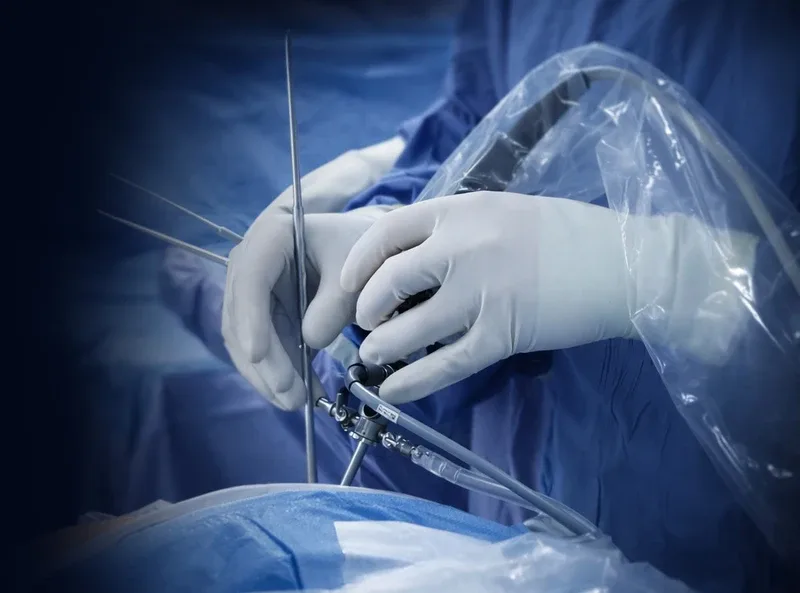
When anatomy and symptoms allow, the team favours posterior endoscopic foraminotomy or discectomy without fusion: this frees the nerve root while preserving the disc and movement.
Some selected cases of spinal cord compression can be treated with posterior decompression (laminectomy) without fusion, after assessing alignment and stability. Fusion may still be needed later.
Every operation carries risks and a recovery period. Indication, discharge time and return to work or sport are always individual and discussed with you before any decision.
Anterior approaches, fusion and disc replacement
ACDF
Anterior cervical discectomy and fusion is an established, effective technique that prevents movement at the treated segment. It remains the right choice in many situations.
Not every anterior procedure requires fusion
A mobile artificial disc is another option. When an implant is needed and disc replacement is appropriate, we consider and favour it to preserve movement.
An individual choice
The technique is chosen for each case: anatomy, symptoms, alignment and stability, rather than a rule that applies to everyone.
Scientific sources
Some clinical studies on endoscopic techniques, for those who would like to read more. They show comparable results in selected populations, not universal superiority.
Been offered neck surgery?
A second opinion helps clarify the indication, timing and whether a motion-preserving technique is appropriate in your case.
Frequently asked questions
Do cervical spine problems often need surgery?
No. Many cases of neck pain and radiculopathy improve with conservative care.
Does cervical spine surgery always mean fusion?
No. Depending on the case, a posterior approach without fusion or a mobile artificial disc may be possible. ACDF remains appropriate in many situations.
Is a video consultation enough for neck problems?
It can be a useful first step. If spinal cord involvement is suspected, an in-person examination is important.
Videos
Original videos published by NeuroNEC and Dr Lechanoine.
The video is loaded from YouTube (youtube-nocookie.com) only after you click: YouTube is an external service with its own terms.
Interviews and explainers with Dr Lechanoine
A first opinion, without travelling.
Around 30 minutes with Dr Lechanoine, arranged by the NeuroNEC coordination team. By sharing his screen, he shows you your imaging and discusses the options with you.
Private visits and care pathways, not covered by the Italian National Health Service (SSN/ASL). A consultation involves no commitment to surgery.