
Lumbar spinal stenosis
When walking becomes harder.
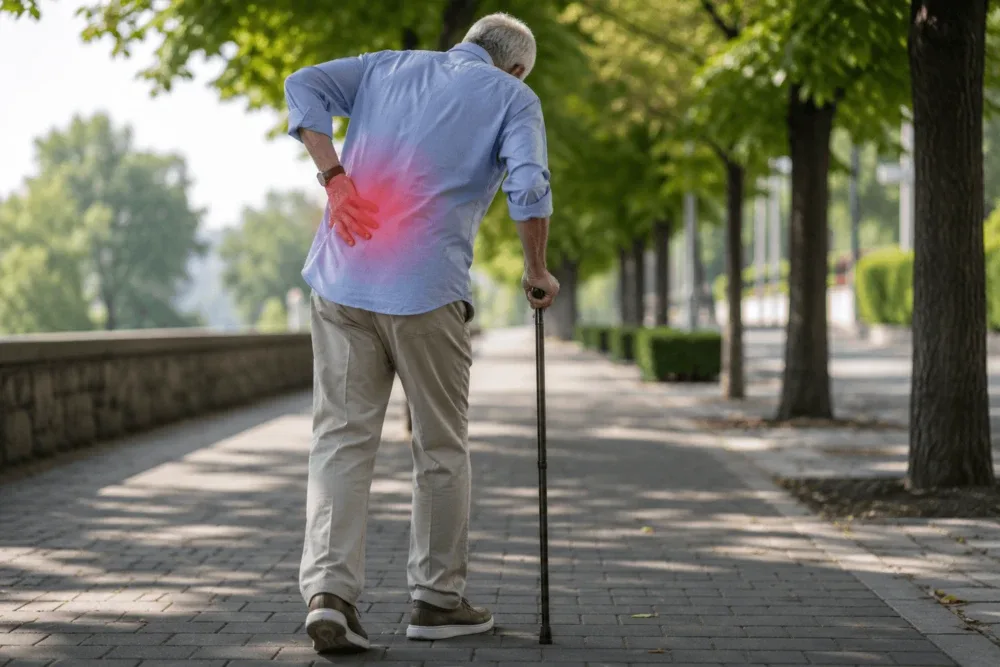
Heavy legs after a few hundred metres, the need to stop or sit. Lumbar stenosis is common with age, and can be approached calmly and methodically.
Private visits and care pathways, not covered by the Italian National Health Service (SSN/ASL). A consultation involves no commitment to surgery.
What it is, in plain words
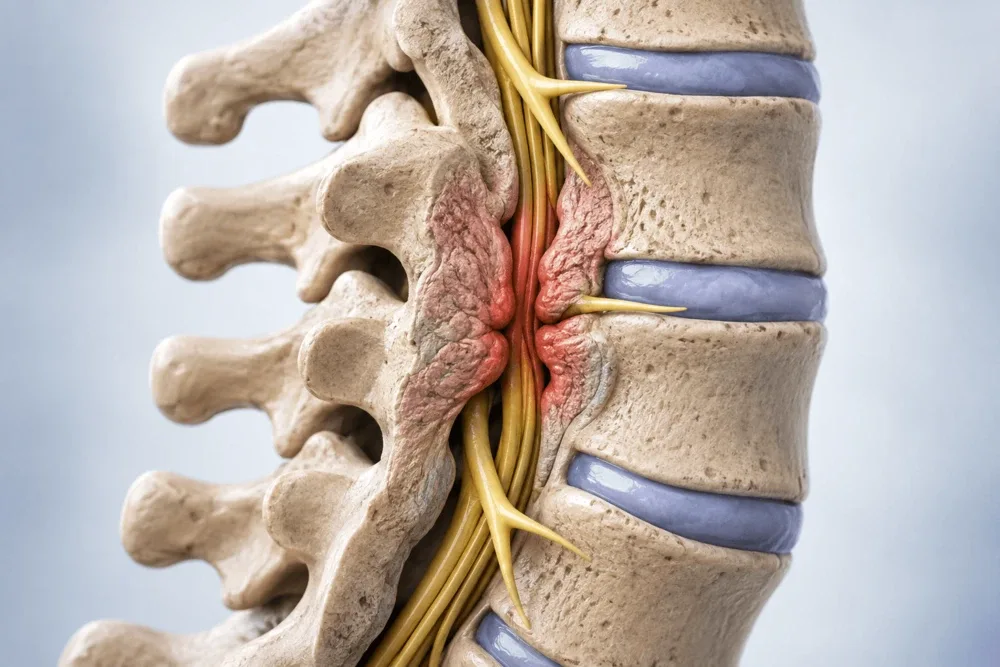
Over the years, discs, joints and ligaments of the spine can thicken and narrow the canal through which the nerves run.
When space narrows, the nerves suffer especially when standing and walking. Leaning forward or sitting often brings relief.
Common symptoms
- Heaviness, pain or tingling in the legs when walking
- Needing to stop, sit or lean forward for relief
- Walking more easily while leaning on something, like a shopping trolley
- Long-standing back pain
The assessment
- Walking distance and impact on everyday life
- Neurological examination and assessment of circulation in the legs
- MRI and dynamic X-rays to assess stability
- Identifying the source of symptoms, including with diagnostic injections
Conservative care
- 01
Exercise and physiotherapy
Programmes to improve posture, strength and endurance.
- 02
Pain management
Medication and, when helpful, guided injections.
- 03
Reassessment over time
Following changes to decide at the right time.
When to discuss surgery
Surgery is discussed when limited walking affects quality of life despite adequate care, or when neurological deficits appear.
The aim is to free the nerves while preserving the structures that provide stability.
Endoscopic decompression
When decompression is indicated, endoscopic decompression is our team’s reference approach.
Through small openings, the space around the nerves is widened while respecting muscles, ligaments and joints. Risks and recovery times remain individual.
Every operation carries risks and a recovery period. Indication, discharge time and return to work or sport are always individual and discussed with you before any decision.
Spondylolisthesis and fusion: not an automatic choice
Slippage does not always mean instability
Mild or moderate degenerative spondylolisthesis, or disc degeneration, does not automatically require fusion. What matters is dynamic stability and the actual source of symptoms.
Decompression first, when possible
Following this assessment, even in these situations it may be possible to start with endoscopic decompression and rehabilitation. Stabilisation remains an option at a later stage.
When fusion is right from the outset
Significant mechanical instability, associated with low back pain that matches the findings, may justify fusion from the outset.
Scientific sources
Some clinical studies on endoscopic techniques, for those who would like to read more. They show comparable results in selected populations, not universal superiority.
Have you been offered fusion?
An assessment can explore whether targeted endoscopic decompression with rehabilitation is an appropriate alternative, without promising to avoid fusion.
Frequently asked questions
Does stenosis always get worse?
Not necessarily. In many people, symptoms remain stable for a long time and can be managed with conservative care.
Does spondylolisthesis always require fusion?
No. It depends on dynamic stability and the source of symptoms. Sometimes fusion is indicated from the outset; at other times, decompression can be the first step.
Is age a barrier to surgery?
Age alone does not decide. General health, symptoms and your goals matter.
Videos
Original videos published by NeuroNEC and Dr Lechanoine.
The video is loaded from YouTube (youtube-nocookie.com) only after you click: YouTube is an external service with its own terms.
Interviews and explainers with Dr Lechanoine
A first opinion, without travelling.
Around 30 minutes with Dr Lechanoine, arranged by the NeuroNEC coordination team. By sharing his screen, he shows you your imaging and discusses the options with you.
Private visits and care pathways, not covered by the Italian National Health Service (SSN/ASL). A consultation involves no commitment to surgery.